
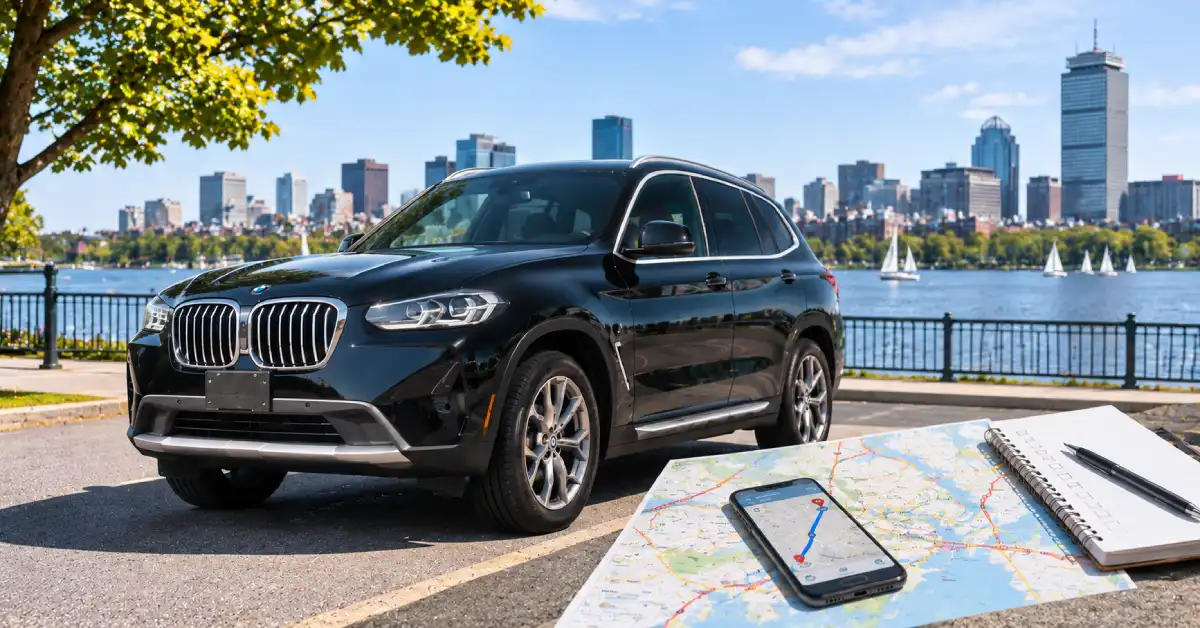
To estimate rental car mileage, add the driving distance between every planned stop, including your return journey, local errands, and a 10–15% planning buffer. Compare your estimated daily mileage with the rental company's included allowance. This helps you select a suitable rental plan and avoid unexpected extra-mile charges.
Planning a Boston-area trip involves more than choosing destinations and booking a vehicle. Your total driving distance can affect rental costs, fuel expenses, and the suitability of your reservation. Even short journeys can accumulate significant mileage over several days.
At Diamond Key Rentals, customers can review mileage allowances when arranging their car rental in Boston. The company publishes different mileage limits based on rental duration. This guide explains how to calculate your expected driving distance and choose an appropriate rental arrangement.
Why Should You Estimate Rental Car Mileage Before Booking?
Rental car mileage represents the distance you drive during your reservation. Some rental companies include unlimited mileage, while others provide a specified allowance.
Estimating mileage beforehand helps you understand how much driving your reservation can accommodate. It also allows you to compare rental options more accurately.
The main benefits include:
- Avoiding unexpected additional-mile charges.
- Selecting a suitable rental duration.
- Comparing economy cars and premium SUVs.
- Estimating fuel expenses more accurately.
- Planning regional trips without overlooking return journeys.
A rental with an attractive daily rate may become more expensive if your itinerary exceeds its included mileage.
How to Estimate Rental Car Mileage in 6 Simple Steps
The easiest approach is to calculate your driving distance before comparing it with your rental allowance.
Follow these six steps to create a realistic mileage estimate for your Boston-area itinerary.
Step 1: List Every Destination on Your Itinerary
Start by identifying every destination you expect to visit during your reservation.
Include your accommodation, business meetings, sightseeing locations, restaurants, shopping stops, and regional day trips. Also record the actual rental pickup and return locations.
Your itinerary might include:
- Your confirmed rental pickup or delivery location.
- Boston Logan International Airport, if relevant to your travel plans.
- Your hotel or accommodation.
- Downtown Boston and the Seaport.
- Cambridge or nearby suburbs.
- A regional destination such as Cape Cod.
- Your agreed vehicle return location.
Diamond Key Rentals offers vehicle delivery options, so your starting point may differ from the airport. Calculate mileage from the actual location where you receive the vehicle.
Step 2: Calculate the Distance Between Each Stop
Use a route-planning application to calculate driving distances between your actual destinations.
For example, enter your hotel's address rather than simply selecting Boston as your starting point. Then add your planned destinations in the order you expect to visit them.
Use driving distance rather than straight-line distance. Roads, bridges, highway connections, and local access routes can make actual driving distances considerably different.
Step 3: Include Your Return Journey
One of the most common mileage-planning mistakes is calculating only the outbound journey.
A destination located 75 driving miles from your accommodation requires approximately 150 miles for a return trip. Additional driving after arrival will increase that total.
If you're planning a coastal getaway, our Boston to Cape Cod rental car guide provides additional route-planning considerations.
Step 4: Add Local Driving and Unplanned Stops
Your main destinations rarely account for every mile driven.
You may visit a supermarket, stop for fuel, change restaurants, or take an alternative route. Parking availability can also influence how far you drive.
Allow additional mileage for these smaller journeys. This creates a more realistic estimate than relying entirely on your main destinations.
Step 5: Add a Mileage Buffer
A mileage buffer is an additional distance allowance for unexpected driving.
For a relatively predictable itinerary, adding approximately 10–15% to your planned mileage is a useful starting point. More flexible itineraries may require a larger buffer.
For example:
- Planned driving distance: 300 miles.
- Additional 15% buffer: 45 miles.
- Estimated total mileage: 345 miles.
This percentage is a planning recommendation, not a Diamond Key Rentals policy.
Step 6: Compare Your Estimate With the Rental Allowance
Once you calculate your expected mileage, review the allowance included with your reservation.
Check whether mileage applies daily or across the rental period. Also confirm the extra-mile rate and whether unused mileage can carry forward.
The Diamond Key Rentals Rental Agreement explains its standard mileage allowances, additional-mile charges, and odometer measurement procedures.
Rental Car Mileage Calculation Formula
You can estimate your expected rental mileage using this simple formula:
Estimated mileage = All planned driving distances + Additional local driving + Mileage buffer
Include return journeys within your planned driving distances. Avoid counting the same journey twice.
Consider this hypothetical three-day Boston itinerary.
| Driving Activity | Estimated Mileage |
| Airport and accommodation journeys | 20 miles |
| Local sightseeing and appointments | 45 miles |
| Regional day trip, including return | 160 miles |
| Shopping, meals, and other stops | 25 miles |
| Subtotal | 250 miles |
| 15% planning buffer | 37.5 miles |
| Estimated total | 287.5 miles |
Rounding the estimate to 290 miles provides a convenient planning figure.
These distances are illustrative rather than measured routes between specific addresses. Calculate actual driving distances using your confirmed pickup location, accommodation, destinations, and return location.
Important: This formula estimates total trip mileage. Review your Rental Record to understand how the included mileage allowance applies to your reservation.
Diamond Key Rentals Mileage Allowances
Diamond Key Rentals publishes standard mileage allowances based on the length of the rental.
| Rental Duration | Included Miles Per Day |
| 1–14 days | 200 miles |
| 15–29 days | 150 miles |
| 30 days or longer | 80 miles |
These are the standard allowances unless different terms appear on your Rental Record.
The company also publishes the following additional-mile charges:
| Vehicle Category | Extra Mileage Charge |
| Economy sedans | $0.35 per mile |
| Luxury vehicles and SUVs | $0.50 per mile |
For longer reservations, the company's monthly car rental information explains the standard 30-day allowance and applicable rental conditions.
Do Unused Rental Miles Carry Over?
Diamond Key Rentals' published Rental Agreement states that unused mileage does not carry forward between rental days or separate reservations.
However, renters should review their individual Rental Record to understand how mileage allowances and additional charges apply.
The agreement also describes using starting and ending odometer readings to determine the distance driven during a reservation.
For example, suppose you drive 50 miles on one day and 250 miles on another. Do not automatically assume unused mileage from the first day will offset the second day's driving.
This is particularly important when your itinerary includes long regional trips followed by shorter driving days.
Sample Mileage Estimates for Boston-Area Trips
The following examples demonstrate how to estimate rental car mileage for different travel arrangements.
All distances are hypothetical planning figures. Actual mileage depends on your addresses, routes, and additional stops.
Example 1: A Three-Day Boston Weekend
A short weekend might include airport travel, city sightseeing, and a regional excursion.
| Day | Planned Driving | With 10% Buffer |
| Day 1: Arrival and local travel | 30 miles | 33 miles |
| Day 2: Regional sightseeing | 140 miles | 154 miles |
| Day 3: Local stops and return | 40 miles | 44 miles |
| Total | 210 miles | 231 miles |
Each day's estimated distance remains below the standard 200-mile daily allowance.
For more vehicle-selection considerations, read our Boston weekend car rental guide.
Example 2: A Seven-Day Boston Business Trip
Business travelers may drive between hotels, offices, client locations, and regional appointments.
| Driving Activity | Estimated Mileage |
| Five days of meetings at 35 miles per day | 175 miles |
| One regional client visit | 160 miles |
| Airport and other journeys | 45 miles |
| Subtotal | 380 miles |
| 15% buffer | 57 miles |
| Estimated total | 437 miles |
Although the weekly total is useful for budgeting, check each day's distance against the daily allowance.
Our business traveler car rental planning guide covers additional considerations for work-related travel.
Example 3: A 30-Day Extended Stay
Diamond Key Rentals' published standard allowance for rentals lasting 30 days or longer is 80 miles per day.
For planning purposes, multiplying 80 miles by 30 days gives a reference figure of 2,400 miles.
However, this calculation should not be interpreted as confirmation that all unused daily mileage can be combined into one unrestricted monthly allowance.
A renter may drive relatively little during the working week but travel considerably farther on weekends.
Review your expected driving patterns and confirm how mileage is assessed under your individual Rental Record.
Our weekly versus monthly rental guide explains how rental duration affects overall value.
How to Calculate Extra Rental Car Mileage Charges
Extra-mile charges depend on the applicable allowance, actual driving distance, and vehicle category.
Use this formula:
Extra mileage charge = Miles exceeding the applicable allowance × Extra-mile rate
Suppose you rent a vehicle for one day and drive 240 miles. Your standard allowance is 200 miles.
Your additional mileage would be: 240 − 200 = 40 miles
The estimated extra-mile charges would be:
| Vehicle Category | Calculation | Extra Charge |
| Economy sedan | 40 × $0.35 | $14 |
| Luxury vehicle or SUV | 40 × $0.50 | $20 |
These examples use Diamond Key Rentals' published standard rates.
The company's agreement determines actual mileage using the vehicle's starting and ending odometer readings. Pickup and return records establish the distance driven.
How Does Mileage Affect Fuel Costs?
Mileage and fuel charges are separate expenses.
A longer itinerary generally requires more fuel. However, fuel consumption also depends on the vehicle, driving conditions, traffic, and driving habits.
You can estimate fuel costs using this formula:
Estimated fuel cost = Planned mileage ÷ Estimated MPG × Fuel price per gallon
For example, a hypothetical 300-mile journey in a vehicle averaging 30 MPG would require approximately 10 gallons.
At an illustrative fuel price of $3.50 per gallon, the estimated fuel expense would be $35. This is a calculation example, not a current Massachusetts fuel-price quote.
When comparing vehicles, our BMW X3 versus Jeep Grand Cherokee guide explains practical differences between these SUV options.
Common Mileage Planning Mistakes
Avoid these mistakes when preparing your itinerary.
Forgetting the Return Distance
A one-way route estimate does not account for the complete journey. Always include your return to Boston or the agreed vehicle return location.
Confusing Mileage With Fuel Economy
Mileage measures distance driven, while MPG measures fuel efficiency. Both matter, but they represent different parts of your travel budget.
Assuming All Rentals Include Unlimited Mileage
Mileage policies vary between rental providers and reservations. Diamond Key Rentals publishes specific daily allowances, so review your applicable terms.
Ignoring Daily Mileage Limits
A low total mileage estimate does not necessarily prevent daily overages. Calculate each day's driving separately, especially for regional trips.
Overlooking Tolls and Parking
Mileage charges do not include every driving expense. Tolls, parking, and fuel should be considered separately.
Our guide to transparent car rental pricing explains additional costs to review before booking.
Mileage Checklist Before Booking
- List every planned destination.
- Calculate driving distances between actual addresses.
- Include outbound and return journeys.
- Add local driving and a reasonable buffer.
- Calculate each day's expected mileage.
- Confirm the included mileage allowance.
- Review extra-mile rates for your vehicle.
- Check whether unused miles carry forward.
- Estimate fuel, parking, and toll expenses.
Once your itinerary is ready, review vehicle availability and applicable reservation terms through Diamond Key Rentals' online booking page.
Frequently Asked Questions
Q1: How do I estimate mileage for a rental car?
Add the driving distances between all planned destinations, return journeys, and local stops. Include a reasonable buffer and compare the estimate with your rental allowance.
Q2: How many miles are included with Diamond Key Rentals?
The standard allowance is 200 miles daily for 1–14 days, 150 miles daily for 15–29 days, and 80 miles daily for 30-day-plus rentals.
Q3: Does Diamond Key Rentals offer unlimited mileage?
Its published rental agreement establishes specific mileage allowances rather than universal unlimited mileage. Confirm the terms shown on your individual Rental Record.
Q4: How much does extra rental car mileage cost?
Diamond Key Rentals publishes extra-mile rates of $0.35 for economy sedans and $0.50 for luxury vehicles and SUVs.
Q5: Should I calculate mileage daily or for the entire rental?
Calculate both. Daily estimates help identify potential overages, while the total estimate supports broader trip and fuel budgeting.
Q6: How much extra mileage should I allow for unexpected driving?
A 10–15% buffer is a useful starting point for predictable trips. Increase it when your itinerary includes flexible sightseeing or uncertain destinations.
Final Words
Understanding how to estimate rental car mileage helps you choose a suitable vehicle and prepare a realistic Boston travel budget.
Start with your planned routes, include return journeys, and add a reasonable buffer. Compare both daily and total driving distances with your rental allowance.
Diamond Key Rentals offers rental options for short visits, business travel, and extended stays throughout Boston.
Planning your next Boston-area trip? Contact Diamond Key Rentals at (617) 214-2242 to discuss your itinerary, vehicle preferences, and applicable mileage terms before booking.