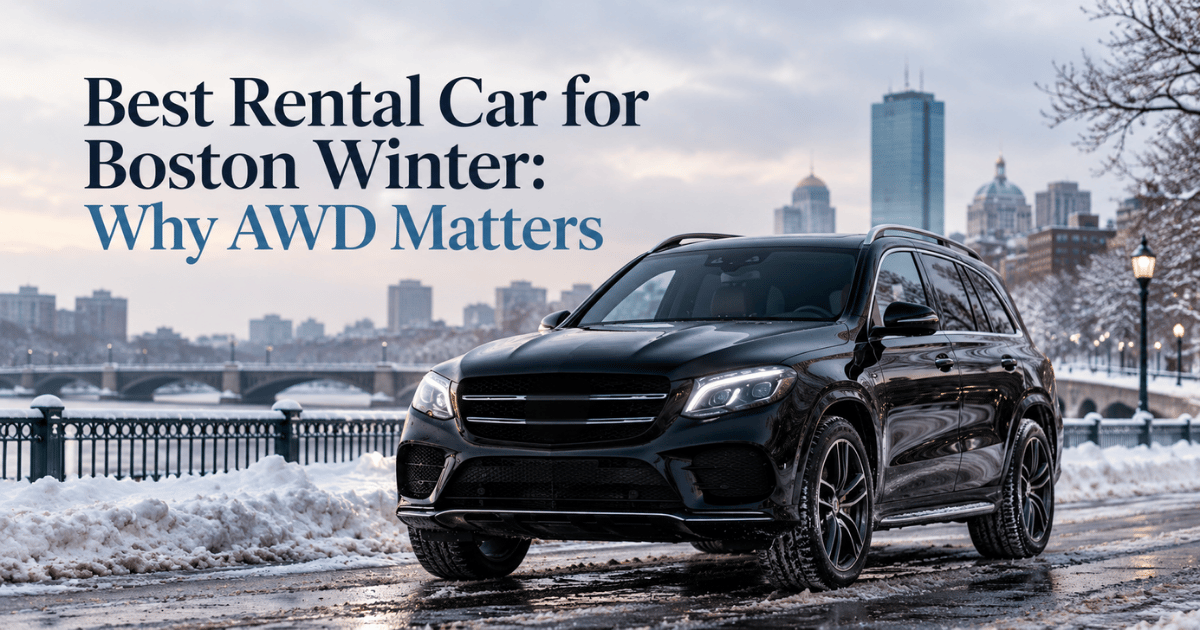
The best rental car for Boston winter is usually one that combines dependable tires, stability control, good visibility, and suitable traction for your route. AWD can help a rental accelerate on snow and slippery roads, but it does not shorten braking distances or eliminate the risks of ice.
Boston winters can bring snow, freezing temperatures, slush, and black ice. Massachusetts officials specifically warn drivers to increase stopping distance and adjust speed during winter conditions. AWD can add confidence when traction is limited, especially for trips beyond central Boston.
At Diamond Key Rentals, we offer vehicles for different Boston travel needs, including AWD and 4x4 SUV options. This guide explains when AWD matters, when it does not, and what else to check before choosing a Boston winter rental.
What Makes a Good Winter Rental?
The best Boston winter rental combines traction, appropriate tires, predictable handling, working safety systems, and reliable cold-weather equipment. AWD is useful, but drivetrain alone should never decide which vehicle you rent.
Massachusetts recommends checking tires, tire pressure, brakes, wipers, washer fluid, battery, lights, defroster, antifreeze, and other components before winter driving.
For a rental, focus on several practical features:
- AWD or suitable front-wheel drive
- Tires with adequate tread
- Electronic stability and traction control
- Anti-lock brakes
- Effective windshield defrosting
- Good visibility
- Reliable heating
- Enough ground clearance for your route
- Enough space for passengers and winter luggage
Your route matters as much as the vehicle.
A short drive through treated Boston streets differs from a winter road trip into northern New England. Therefore, match the rental to where you actually plan to drive.
Why Does AWD Matter?
AWD matters in Boston winter because it can send power to more than two wheels when available traction becomes limited. That can help the vehicle get moving on snow, climb slippery grades, and maintain forward progress where a two-wheel-drive vehicle may struggle.
AAA Northeast explains that AWD improves traction in snowy conditions. However, its automotive experts also stress that AWD cannot replace suitable tires.
Imagine two tires begin slipping while pulling away on snow. An AWD system can use traction available at other driven wheels to help the vehicle move.
That advantage can become useful when:
- Leaving a snowy parking area
- Starting on a slippery incline
- Driving through accumulated snow
- Traveling before roads are completely cleared
- Taking winter trips outside central Boston
However, AWD has an important limitation.
It helps you go. It cannot guarantee that you stop.
Does AWD Help on Ice?
AWD offers limited protection on ice because braking and cornering depend heavily on tire grip. Black ice can overwhelm AWD, four-wheel drive, traction control, and other vehicle systems.
MassDOT specifically warns that black ice can cause a vehicle to lose traction during turning or braking. Its guidance also notes that four-wheel drive does not solve the problem when a vehicle encounters black ice.
That distinction matters when choosing an AWD car rental for Boston winter.
A driver can feel strong acceleration and assume the road has plenty of grip. The same vehicle may still slide when braking.
Therefore:
AWD ≠ unlimited winter traction.
Your speed, tires, following distance, steering inputs, braking, and road conditions remain critical.
AWD vs FWD in Winter
Both AWD and front-wheel drive can work during a Boston winter. AWD generally provides an advantage when accelerating in deeper snow or on slippery surfaces, while FWD can remain practical on cleared and treated urban roads.
| Feature | AWD | FWD |
| Snow acceleration | Better traction potential | Generally capable |
| Slippery hills | More helpful | More dependent on tire grip |
| Deep snow | Usually preferable | More limited |
| City driving | Very capable | Often sufficient |
| Braking on ice | Tire-dependent | Tire-dependent |
| Fuel economy | Often lower | Often better |
| Winter tires still matter | Yes | Yes |
| Driver caution required | Yes | Yes |
The most important takeaway is simple.
Do not compare drivetrains without considering tires.
AAA notes that winter tires use compounds designed to remain more flexible in cold weather. Their tread patterns also improve traction in snow and ice.
An AWD vehicle on unsuitable or badly worn tires can therefore be a poor winter choice.
SUV vs Sedan for Winter
An AWD SUV can be useful for Boston winter trips involving snow accumulation, luggage, or travel beyond city streets. A sedan may be more practical for normal city driving, easier parking, and trips made after roads have been cleared.
Neither body style automatically makes a vehicle safer.
AWD SUV
An AWD SUV becomes particularly attractive when you expect:
- Snow-covered secondary roads
- Longer New England trips
- More passengers
- Winter luggage
- Uneven snowy parking areas
- Greater snow accumulation
Higher ground clearance can also help when snow becomes deeper.
AAA Northeast recommends considering an AWD sedan or SUV for serious winter conditions. It also notes that an SUV's higher ground clearance can help in deeper snow.
Sedan
A sedan can make sense when your plans mainly involve:
- Central Boston
- Cleared main roads
- Hotel-to-business travel
- Limited luggage
- Urban parking
- Mild winter conditions
Do not rent a larger SUV simply because it looks more winter-ready.
Choose a vehicle you can control comfortably.
When Do You Need AWD?
AWD becomes most useful when your Boston trip has a realistic chance of involving snow-covered roads, hills, unplowed areas, or travel outside the city. It becomes less important when conditions are dry and your route stays on cleared urban roads.
Consider prioritizing AWD for:
Snowy Forecasts
Boston weather can change during a multi-day rental. AWD provides additional traction capability if snow develops during your booking.
It still does not mean you should drive during a major storm.
Massachusetts advises avoiding winter-storm driving unless travel is absolutely necessary.
Trips Beyond Boston
Travel outside Boston may expose you to different road conditions.
Routes toward ski areas, rural New England destinations, or less-traveled roads can involve more snow than central city streets.
Longer Winter Rentals
Weather becomes harder to predict as rental duration increases.
Someone renting for several weeks may experience dry pavement, rain, freezing conditions, and snow within the same booking.
Having AWD can provide additional flexibility.
Early or Late Driving
Road surfaces can become especially difficult when temperatures fall.
MassDOT warns that bridge decks freeze before surrounding roads. Drivers should also watch ramps and areas where road treatment differs.
What Else Should You Check?
Tires should be one of your first checks when choosing a winter rental. AWD distributes available traction, but the tires create the vehicle's contact with the road.
Ask about or inspect:
- Tire condition – Look for adequate tread and obvious damage.
- Tire type – Determine whether the vehicle has suitable all-season or winter tires.
- Defroster – Confirm the windshield clears properly.
- Wipers – Good visibility matters during snow and slush.
- Washer fluid – Winter roads can quickly coat windshields.
- Lights – Snow and shorter daylight hours increase visibility concerns.
- Heating – Confirm the climate system works correctly.
- Vehicle controls – Locate traction control, defrost, lights, and wipers before leaving.
Massachusetts specifically recommends checking snow tires, tread, tire pressure, brakes, defrosters, batteries, lights, and winter fluids.
This creates a better winter-rental checklist than asking only, “Does it have AWD?”
Boston Winter Rental Options
Diamond Key Rentals currently lists both SUV and sedan options for different Boston trips.
For winter travelers interested in SUVs, current fleet listings include the BMW X3 and Jeep Grand Cherokee. Vehicle availability can change, so confirm your dates before planning around a particular model.
Browse the current Diamond Key Rentals fleet to compare available vehicles.
A BMW X3 can provide a premium SUV format with AWD capability. A Jeep Grand Cherokee can also suit travelers looking for SUV space and winter-oriented capability.
For lighter city use, a sedan may still make more sense. Your actual route and weather forecast should guide the decision.
Boston Winter Driving Tips
Drive more slowly and leave additional stopping distance whenever Boston roads become snowy or icy. AWD cannot compensate for excessive speed, sudden steering, or hard braking.
MassDOT recommends several winter-driving precautions.
Follow these essentials:
- Clear snow and ice from the vehicle before driving.
- Reduce speed for the actual road conditions.
- Increase the space between vehicles.
- Brake earlier than you would on dry pavement.
- Avoid cruise control on slippery roads.
- Watch bridges and overpasses for early freezing.
- Give snowplows plenty of space.
- Check weather and road conditions before leaving.
Also avoid sudden acceleration.
AWD may make rapid acceleration possible, but that does not mean surrounding road conditions support the same speed.
If conditions become severe, delaying the trip can be safer than relying on vehicle technology.
Choosing Your Winter Rental
Choose your Boston winter rental around the hardest conditions you reasonably expect, not simply the average day of your trip. AWD is worth considering when snow, longer trips, hills, or less-cleared roads are realistic possibilities.
Use this quick decision guide:
| Your Trip | Practical Choice |
| Boston city, clear roads | Sedan or SUV |
| Snow likely | AWD worth prioritizing |
| Longer winter rental | AWD adds flexibility |
| New England road trip | AWD SUV worth considering |
| Deep snow possible | AWD + suitable tires + clearance |
| Severe active storm | Avoid unnecessary driving |
Before reserving, review Diamond Key Rentals' car rental FAQ for booking information and rental requirements.
You can also review our guide to Boston airport car rental prices if your winter trip begins at Boston Logan International Airport.
Frequently Asked Questions
Do I need AWD in Boston winter?
Not for every winter day. AWD becomes more useful when snow, slippery hills, unplowed roads, or longer New England trips are likely. A FWD vehicle with appropriate tires can still handle many cleared Boston roads. Always choose based on current conditions and your route.
Is AWD better in Boston snow?
AWD generally provides better acceleration traction in snow because the system can distribute power across more wheels. However, it does not automatically improve braking on snow or ice. Tire grip, speed, and driver inputs remain critical.
Is an SUV best for Boston winter?
An AWD SUV can be a practical winter rental because it combines traction capability, passenger space, and ground clearance. However, a sedan may be easier for Boston parking and perfectly suitable on cleared roads.
Does AWD stop faster on ice?
No. AWD mainly helps distribute driving power to the wheels. It does not give the tires additional braking grip. MassDOT warns that four-wheel-drive features do not overcome black ice.
Do AWD cars need winter tires?
AWD vehicles still depend on their tires for acceleration, cornering, and braking. Winter tires use cold-weather compounds and tread designs to improve grip. AWD should not be treated as a replacement for appropriate tires.
What rental is best for snow?
For meaningful snow, an AWD sedan or SUV with suitable tires is a strong option. An SUV can add ground clearance for deeper accumulation. Vehicle condition and tire quality remain as important as drivetrain.
Can I rent an AWD SUV in Boston?
Diamond Key Rentals’ current SUV options include an AWD BMW X3 and a 4x4 Jeep Grand Cherokee. Always verify the exact vehicle and availability for your rental dates. Always verify the exact vehicle and availability for your rental dates.
Final Takeaway
The best rental car for Boston winter is not simply the biggest SUV available. The right vehicle combines suitable tires, predictable handling, visibility, safety systems, and enough traction for your actual route.
AWD matters because it can improve acceleration and mobility when snow reduces traction. However, AWD cannot defeat black ice or shorten every slippery-road stop. Tires, speed, following distance, and weather awareness remain essential.
At Diamond Key Rentals, we offer Boston rental options for city travel, longer stays, and seasonal trips. If winter conditions or travel beyond Boston are part of your plans, an AWD SUV may provide the additional capability you want.
Explore our available rental fleet, then book your Boston rental online when your dates and route are ready.